Deaf Missions International
    Meeting special educational needs of deaf children and deaf adults through
                    Educational Research, Development & Application.


    Apart from establishing educational classes for deaf children and deaf adults, DMI assist
    educational Institutions that are Government, Private or  Religious to develop or  improve
    their special educational curriculum and  facilities design on behalf of deaf students. Having
    the right educational tools helps teachers to better assist deaf students to attain their  highest
    educational  level desired.

    When deaf people are discovered in any part of the world, and  it is  known that  no
    educational services are provided  or only provide speech therapy...  DMI's develops two
    research & Development Teams ... "A-Team" &" B-Team".   "There are a number of teams
    involved  in the entire process... but I will not mention them here.

    To  began the educational process,  the language  and the culture of the deaf community
    must be discovered, captured and understood in order  to develop the appropriate
    educational material.

    If the deaf within the aggregate society are not coming together as a community to realize
    that there are others with  the same attitudes and interests in common... then A & B teams
    have and additional responsibility to locate and bringing the deaf together which establishes
    the active and functional deaf community within the country. What is first noted is the
    exchange of concepts with one another  through body movements facial expressions and
    formation hand movements "a real language they understand".  This is when the team
    members first see a change in the life of  an isolated an inactive deaf individual.  For the first
    time they feel they belong, the deaf community actually becomes to them a family. In the
    community the deaf individuals began a mental development because there they receive
    and exchange concrete and abstract concepts in a visual language they understand. With
    their relatives the communication is limited to finger pointing and sometimes basic
    gestures.  Some times a deaf community or deaf communities are already established due
    to a charismatic deaf leader or deaf leaders deaf adults  follow.  In order to receive their
    corporation, confidence must be earned by the team. And that is accomplished by giving
    attention to what they desire.

    However, Team "A" with the cooperation of the deaf community  initiates and completes the  
    Dactylology research.

    The research   consist of presenting a many visual concept to each deaf member
    independently, recording their hand and finger movement including the body and facial
    expression.  The Dactylology expressing a concept  by several  deaf candidates
    independently is recorded as authentic and certified  by the deaf community.  

    Team "B" must be individuals who do not know the verbal nor written language of the hearing.
    While Team A who knows the written and audible language is capturing the Dactylology,
    Team B initiates the process of  learning the written language  in order to discover  the same
    difficult  challenges that deaf student may also encounter.  This knowledge helps in the
    development of the educational materials that will be created with the assistance of
    discovered or trained teachers.

    The challenges encountered  may or may not require the development of a modified
    Dactylology a second language for the deaf students who desire to go onto superior
    education. Modified Dactylology is a second language for the purpose of learning to read
    and write not a replacement of Dactylology in the natural state that is developed and
    preserved  within a deaf person according  to the visual  culture that surrounds the deaf
    community.

    After the study &  material Development of the captured  Dactylology Language, including  
    the deaf culture and unified behaviors (psychology of deafness) ...    the following phase of
    the educational process began the Teams' effort to  discovers  teachers  with a commitment  
    to learn  the language of theses special people"  including their culture and the psychology
    of deafness.  All three materials with a good attitude are necessary in order for the teachers  
    to earn the confidence of the deaf students and accomplish the educational goal.  After the
    teachers training, The "A" Team, and the teachers formulate the Educational Committee to
    develop the educational curriculum.  

    The bridge of communication must first be established between the teacher and the deaf
    student in order to help the deaf student to build the Main Bridge of communication to the
    members of the hearing society.   That bridge of communication is not sign language
    "Dactylology"... and that bridge of communication is not speech therapy, both are valuable  
    tools to help the student understand  in order to build "develop"  the Main bridge of
    communication with the hearing society. The Main bridge is the ability to read and write the
    written language of the Culture wherein the subculture resides. The Hearing members of the
    Society developed and uses the silent language of characters to communicate concepts.
    Now it is up to the deaf student to attain the ability to read and write to the best of their ability.  
    Alone without teachers they can not accomplish their goal.  And teachers without the right
    material and facilities can not assist the deaf student. In other words, Teachers with the right
    attitude, including materials and appropriate  facilities can help deaf students build the Main
    Bridge of communication on to a superior education.

    When the communication between the teacher and the students is harnessed,  The lesson
    that follows is the Psychology of the Hearing in reference to ethics.  This lesson will help deaf
    individuals to cease receiving angry and disappointing looks from the hearing. Although
    there are many ethical subjects, the one I will close with is the ethic of eating soup.  There are
    many deaf people "children and adults" to no fault of their own  "surp...surrrrp"  the soup
    from the spoon... simply because they are in the vacuum of silence  and have never been
    told that slurping make a noise that is not pleasant to hear... therefore it is impolite.   Then
    comes the complicated questions in the language of the deaf: "What is noise?" & " What is
    "...to hear".  But, there are other deaf people that have no problem at all with slurping the
    soup... reason? To slurp the soup is part of the culture and therefore not considered
    unethical. When I am alone... I enjoy just picking up the bowl of soup, tilt and slurp! But due
    to the culture, in the presence of others... I would never do it... nor do I like hearing others
    slurp.


    History

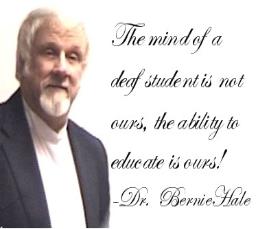
    In 1969 visiting the educational institutions for deaf children In South America,   Dr. Hale
    discovered that they held to an old method  of first developing the ability to speak and read
    lips and then proceed to with an educational curriculum.  Speech therapy is meaningful to
    discover the exceptional few deaf individuals who can attain the speech ability. However,  
    continuing the same with a deaf students who fail to attain speech reveals a lack of
    knowledge In the psychology of deafness that relates to the thought and memory process of
    majority of deaf people.

    In view of the lack of special educational materials to assist  teachers to educate the deaf  
    student, and  the reluctance of Government educational directors to accept the manual
    communication of their own deaf people as a real  language, Dr. Hale  provided his Board of  
    Trustees a brief report. The report informed his intentions to return  and to reveal a more
    natural method that would improve the process of the speech therapy and allow eduction to
    be began immediately. " The Dactylology Visual Memory method."

    "Speech Therapy serves to discover the small percentage  of deaf students who can
    attain the ability to speak and read lips. But, for the majority  of the deaf students who
    fail . . . to consume deaf student's limited educational time with the same failing therapy
    is an act of being irresponsible! Especially when there is another method with the use
    of their own natural language that will allow deaf students an easy access to education."

    In an effort to make a difference, Dr. Hale resigned from his position as Senior Pastor In the
    US to begin his international mission lecturing on the Psychology of Deafness at several
    Universities In South America and the United States. The lecture included inserts
    concerning his research and development   of  the visual memory educational method "a
    curriculum designed for the 90% of the deaf students who fail speech therapy methods.

    The special lecture gave  teachers the understanding that by learning the language of the
    deaf  they bridged the communication gap to their deaf student  In order to relay clear and
    deeper educational concepts on to a superior education.  
DMI - Deaf Missions International
PO Box 8514 - Clearwater, Florida 33758
(727) 530-3020 -DMI@DMInetwork.org